At what wind speed does outdoor use of aerial work platforms become a risk?
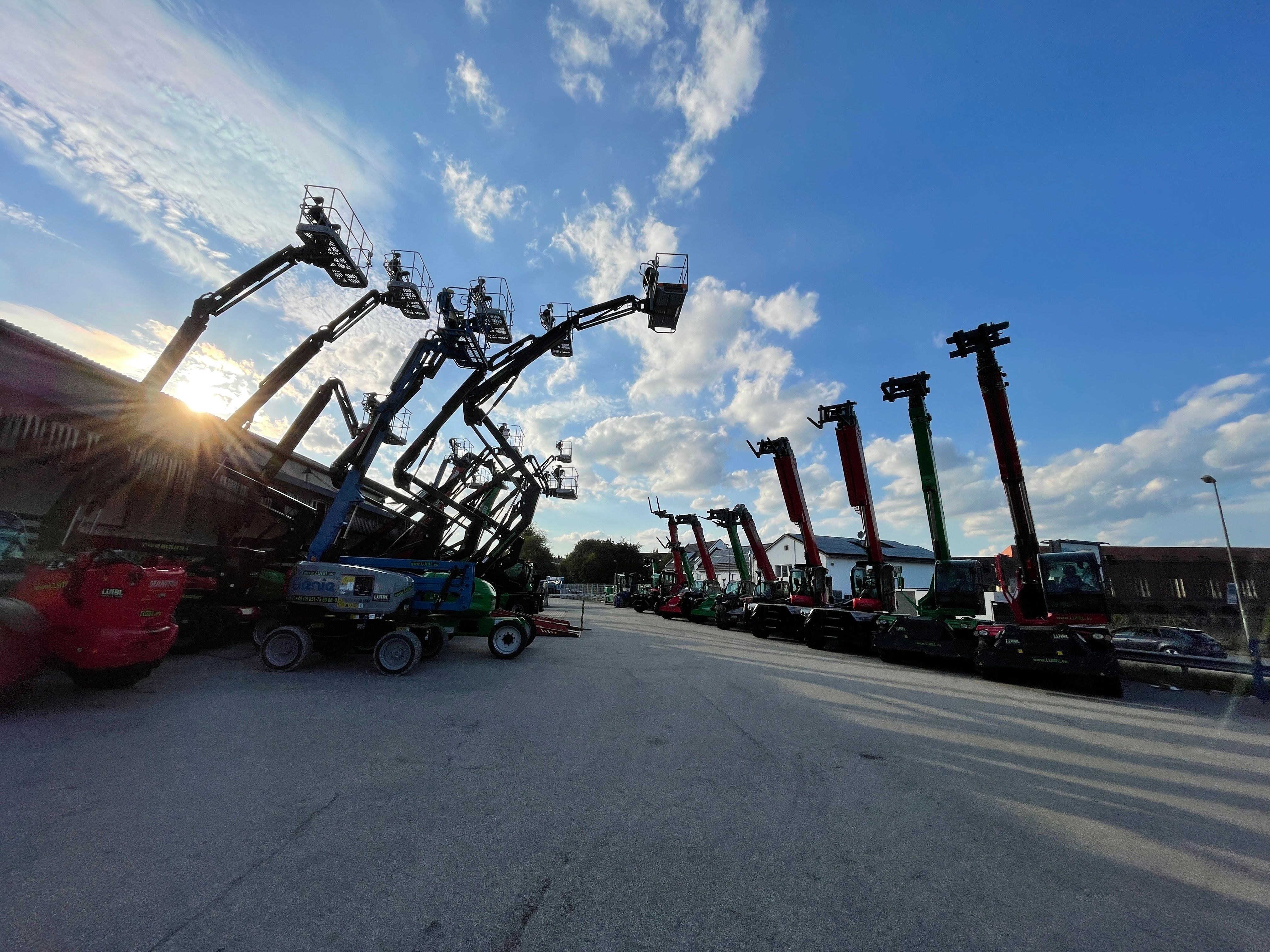
A sudden gust of wind at a height of 25 metres can tip over an aerial work platform, even if the rated load of the platform has not been exceeded at all. Wind load acts in addition to the weight of persons, tools and material and fundamentally changes the stability of the machine. For site managers who use scissor lifts, articulating boom lifts or truck-mounted platforms outdoors, the question of the permissible wind speed is therefore not a side issue but one of the key safety decisions before every outdoor job.
The standard value: 12.5 metres per second as the industry standard
Mobile elevating work platforms are generally designed to CSN EN 280 for a maximum wind speed of 12.5 metres per second - this corresponds to 45 kilometres per hour or force 6 on the Beaufort scale, colloquially called a "strong breeze". At this wind force whole branches are already moving and using umbrellas becomes difficult - an easily understood reference point for site practice.
The limitation is important, however: 12.5 m/s is the design value most frequently used in the industry, but not a universal law. The actually permissible wind speed depends on the model and must be checked in the operating manual of the respective machine. Some machines, especially compact scissor lifts with a large wind-exposed area when the platform is extended, may specify lower limits. Anyone who blindly relies on the general guideline value without checking the specific machine manual takes an incalculable risk.
The Beaufort scale as a practical assessment tool
As a precise anemometer is rarely at hand on construction sites, the Beaufort scale helps with a quick assessment on site. From force 4 (moderate breeze, about 20 to 28 km/h) thin branches already move noticeably, which can lead to perceptible swaying on aerial work platforms at great height. Force 5 (fresh breeze, 29 to 38 km/h) sets larger deciduous trees in motion. At force 6 (strong breeze, 39 to 49 km/h, corresponding to around 12.5 m/s) the critical limit for most mobile elevating work platforms is reached. From force 7 (near gale) upwards, outdoor use of aerial work platforms is impermissible without exception.
Anyone who regularly works outdoors should not rely on their own feel for the wind, but should make a local weather warning or a simple wind meter a fixed part of daily planning. Many modern construction site weather stations provide live values that can be compared directly with the Beaufort scale.
Why wind load affects stability differently from the platform load alone
The stability of an aerial work platform is determined by the interplay of dead weight, load, outreach and wind-exposed area. While the load acts as a vertical force, the wind acts laterally on the structure - on the platform, the boom and the persons in the basket. To calculate wind load, an exposed area of 0.7 square metres per person is usually assumed, which is included in the stability calculation in addition to the platform area itself.
With articulating boom lifts this effect increases with outreach: the further the boom is extended sideways, the longer the lever arm through which a lateral wind force acts on the tipping point of the machine. For this reason, many manufacturers specify lower permissible wind speeds at maximum outreach than in the basic position. Scissor lifts are less affected by this effect as their lifting movement is purely vertical, but here too the wind-exposed area increases continuously with platform height.
Roto telehandlers in basket mode: additional standard requirements
If a roto telehandler with a personnel basket is used as a mobile elevating work platform, CSN EN 280-2, which applies specifically to work platforms with load handling devices, applies in addition to the basic standard CSN EN 280-1. Details are summarised in the guide to CSN EN 280. For wind assessment this means in practice: the dynamic load moment control of modern machines takes into account not only the basket load, but also the current outreach and the angle of inclination - parameters that come under additional pressure under wind influence. Older machines that only monitor the rated load do not give differentiated feedback here and must therefore be handled more carefully in windy conditions.
What to do if the limit is exceeded
If the permissible wind speed is exceeded during the job, the platform must be lowered immediately and operation stopped - regardless of how far the current task has progressed. Continuing "until the next break" is not a justifiable option, as gusts can briefly be significantly above the average value, even if the mean wind speed still appears to be within the permissible range. Site managers should define this stopping point already when planning the job, so that the decision in the specific moment does not depend on the individual judgement of the operator under time pressure.
Wind load as part of the risk assessment
Wind speed and stability are not an isolated topic but belong in every risk assessment prepared before an aerial work platform is used outdoors. In addition to the wind forecast for the day of the job, this also includes assessing the surroundings: building edges, passages between high-rise buildings or open areas can create local wind amplification well above the general weather forecast. If you are unsure how to systematically include wind load in your own risk assessment, the guide to periodic inspections under Government Regulation No. 378/2001 Coll. and machine documentation provides the organisational context and an overview of which inspection and documentation requirements additionally apply to the respective platform type.
The right machine for wind-exposed locations
For locations permanently exposed to wind - such as high-rise roofs, bridges or free-standing facades - it is worth looking at the wind-exposed area already when choosing the machine. More compact diesel scissor lifts with a smaller platform area offer the wind less surface than large models with extended platform extensions. Details on the available diesel rough-terrain scissor lifts are summarised in the corresponding guide. For articulating boom lifts, we recommend consulting the Luibl Rental team on the specific wind class of the respective model, especially for jobs with an expected high outreach.
FAQ: wind speed and stability of aerial work platforms
At what wind speed must the use of an aerial work platform be stopped? The usual industry limit is 12.5 m/s (45 km/h, Beaufort force 6). The actually permissible value for the specific machine is stated in the operating manual and may be lower.
Does the wind limit also apply indoors? No, the wind load limit only concerns outdoor use. Indoors this hazard does not exist, although other factors such as draughts through open doors should be considered in individual cases.
How can I estimate the wind speed on site without a measuring device? The Beaufort scale offers practical reference points: if whole branches are already moving and using umbrellas becomes difficult, force 6 and thus the critical limit has usually been reached.
Does the permissible wind speed change with the outreach of the platform? Yes, with articulating boom lifts the permissible wind speed often decreases with increasing lateral outreach, as the lever arm for the wind force becomes longer. Manufacturer specifications are decisive here.
Does the same wind limit apply to roto telehandlers with a personnel basket as to conventional aerial work platforms? Basically yes, but the standard CSN EN 280-2 for load handling devices also applies. The dynamic load moment control of modern machines takes wind influence into account indirectly via outreach and angle of inclination.
Questions about the right machine for wind-exposed locations are answered by the Luibl Rental team during service hours Mon-Fri, 8:00-17:00.