Scissor lifts: types, heights and applications at a glance
Short answer: what is a scissor lift?
The scissor lift is the workhorse among aerial work platforms: large platform, high load capacity, vertical lift - ideal wherever you can lift directly below or at the work location.
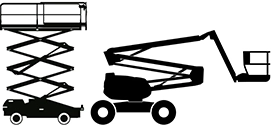
A scissor lift (also called a scissor work platform or scissor lifting platform) raises its platform vertically by means of an extending scissor mechanism. Unlike articulating boom lifts or mast lifts, it has no outreach - but it offers by far the largest working area and the highest load capacities in its class. Many models feature an extendable platform deck that allows limited overreach (for example over a rack or plinth).
This guide explains the designs, helps you choose the right working height and names the limits beyond which a different platform is the better choice. The data comes from the Luibl rental fleet, which includes scissor lifts from 6.30 m to 33 m working height and with load capacities of up to 1,000 kg.
Scissor lift types at a glance
Electric scissor lift for halls and interior fit-out
Battery-powered, free of local emissions, quiet and with non-marking tyres - the standard for everything that happens under a roof: hall renovation, drywall construction, ventilation and electrical installation, exhibition stand construction, logistics. Narrow models start at 0.76 m width and therefore fit through standard doors and into goods lifts. The rental fleet covers 6.30 m to 33 m working height and 227 kg to 1,000 kg load capacity here.
Diesel scissor lift for shell construction, facades and outdoor terrain
All-wheel drive (4x4), oscillating axle and hydraulic outriggers: diesel scissor lifts drive on gravel, topsoil and unpaved construction ground and level themselves even on sloping terrain. The top models offer extendable working platforms from 7 to over 9 metres in length, load capacities up to 1,000 kg and working heights up to around 34 m.
High-rack scissor lift for logistics centres
The specialist class for modern logistics: extreme working height combined with a narrow width, matched to the aisle widths of common high-bay warehouses, and depending on the model drivable at full working height. 18.50 m to 33 m working height, load capacities of 500 to 1,000 kg - for stocktaking, maintenance, sprinkler installation and warehouse conversion.
Hybrid and Bi-Energy scissor lift for alternating operation
The answer for projects that alternate between outdoor terrain and indoor halls: a diesel generator takes the machine over unpaved ground to the site and charges it independently of the mains; indoors, it switches to pure battery operation. 11.75 m to 27.20 m working height, 363 kg to 1,000 kg load capacity - one transport, one briefing, no machine change.
What working height do I need?
The working height is the platform height plus around 2 metres of reach. As a guide by trade:
| Working height | Platform height | Typical applications |
|---|---|---|
| 6-8 m | 4-6 m | Interior fit-out, drywall construction, electrical installation on ground/1st floor |
| 10-12 m | 8-10 m | Hall lighting, ventilation installation, facades of 2-3 storeys |
| 14-18 m | 12-16 m | Industrial halls, steel construction, sprinkler systems |
| 20-26 m | 18-24 m | Large hall bays, facades up to 7 storeys, shell construction |
| 28-33 m | 26-31 m | High-bay warehouses, crane runways, tall industrial plants |
Important: always plan for the reach position you actually need, not the ceiling height - and if in doubt, choose one size larger rather than balancing on the edge of the guardrail.
Load capacity, platform size and number of persons
Compact electric models carry from 227 kg (two persons plus tools), the large diesel, high-rack and hybrid machines up to 1,000 kg. This makes the scissor lift the only platform type that can sensibly move heavy material at great height.
Two details are regularly overlooked:
- The platform extension usually has its own, significantly reduced load capacity - it does not extend the overall load capacity.
- The permissible load capacity may be reduced depending on wind outdoors; the information in the operating manual of the respective machine takes precedence.
Anyone who regularly needs heavy material at height plans by load capacity - not just by height.
Limits of use: when a scissor lift is not the right choice
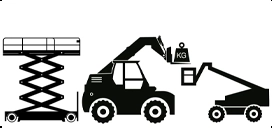
Honest advice is part of the deal: a scissor lift only lifts vertically. As soon as there is an obstacle between the standing position and the work location - a roof overhang, a machine, an extension - outreach is needed. Then the articulating boom lift is the right machine.
For work along public roads with frequently changing locations, a truck-mounted platform is more efficient - which type suits when is explained in the guide Truck-mounted platform. For delicate floors, narrow access and steeply sloping or very soft terrain, the spider lift is the safe alternative.
An overview of all designs is provided by the main guide Aerial work platforms: types and selection criteria.
Operation and qualification
Scissor lifts are aerial work platforms - operators need the required operator qualification in line with applicable Czech safety rules and CSN EN standards, provided by external training providers; we also recommend written authorisation by the employer. What this involves and who offers it is explained in the guide Who may operate an aerial work platform?.
On handover of every rental platform, you also receive a machine-specific operator briefing from us - it supplements the qualification but does not replace it.
Rent a scissor lift from Luibl
Luibl Rental rents out electric, diesel, hybrid and high-rack scissor lifts with working heights from 6.30 m to 33 m - with a valid periodic inspection and delivered by low-loader from Passau throughout the Czech Republic. We will clarify which platform suits your project in a short conversation.
Rent a scissor lift -> | Aerial work platform rental: cost overview -> | Send an enquiry ->
Indoors: door widths, floors and lifts
Most scissor lifts work under a roof - and there it is not the height that decides the choice of machine, but the route to the work location.
Machine width. Narrow models start at 0.76 m and therefore fit through standard doors with a clear width of 0.80 m. From a machine width of around 1.20 m, double doors or gateways are needed.
Floor load. A 12-metre electric scissor lift weighs between two and four tonnes depending on the model, distributed over four wheels. For existing floor slabs, screed over insulation and underground car parks, the permissible point load must be clarified in advance - if in doubt, work with load-spreading pads.
Transport by lift. Compact models are designed for goods lifts; cabin dimensions, door width and load capacity are decisive. If the machine does not fit into the lift, the only options are a crane over the facade or a smaller class.
Height in transport position. The clearance height of retracted scissor lifts is typically between 1.80 and 2.50 m. In underground car parks with 2.00 m clearance, larger models are therefore ruled out even before the height question.
Anyone who knows these four dimensions in advance avoids the most common wrong delivery of all: the right platform that cannot reach the work location.
Inspection and operator obligations
The same obligations apply to operating a scissor lift - rented or purchased - as to any aerial work platform:
- Pre-use check by the operator: emergency stop, emergency lowering, controls, safety devices, tyres, leaks.
- Periodic inspection under Government Regulation No. 378/2001 Coll. by a competent person, documented in the operating records. For rental machines, the valid certificate is supplied with the machine.
- Risk assessment for the specific job, including a rescue plan: emergency lowering must be operable from the ground, and a second briefed person must know how it works.
- Qualification and written authorisation of the operators - see required operator qualification.
- Wind limits according to the operating manual - they apply to the wind speed at working height, not at ground level.
These obligations do not pass to the rental company. Luibl provides the inspected machine together with the certificates and gives a machine-specific operator briefing; responsibility for the job remains with the operator.
Frequently asked questions
What is the difference between a scissor lift and an aerial work platform?
'Aerial work platform' is the umbrella term for all elevating work platforms. The scissor lift is one type: vertical lift via a scissor mechanism, large platform, high load capacity, no outreach.
What heights do scissor lifts reach?
In the Luibl rental fleet, scissor lifts range from 6.30 m to 33 m working height. Compact electric models mainly cover the range up to 14 m, high-rack and large diesel scissor lifts the range above.
Can a scissor lift be used outdoors?
Yes - diesel and hybrid scissor lifts with all-wheel drive and oscillating axle are built for this. Electric models are designed primarily for paved surfaces and indoor spaces; some are approved for outdoor use on level, firm ground.
How much can a scissor lift carry?
Depending on the class, 227 kg to 1,000 kg. The extendable platform deck has its own, lower load capacity.
Who may operate a scissor lift?
Operators need the required operator qualification in line with applicable Czech safety rules, provided by external training providers; we also recommend written authorisation by the employer.
What does it cost to rent a scissor lift?
It varies depending on height, drive and rental period. Specific ranges and all cost factors can be found in the cost guide.